



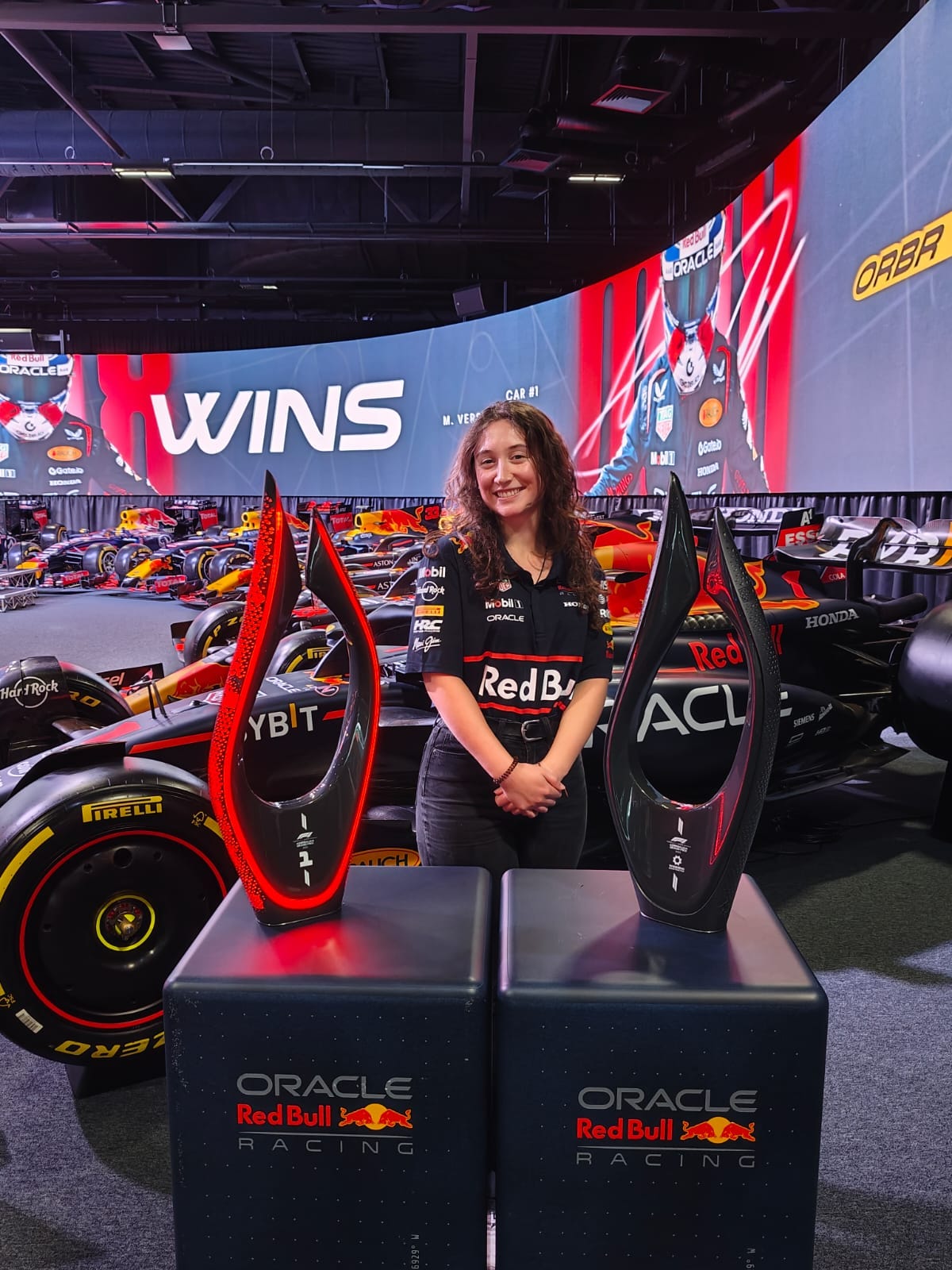
For the second episode of Sexy Jobs with Julia Novis, I am joined by Claire Bonnisseau, who currently works as a Data Strategy and Insights Engineer at Red Bull Powertrains. Claire also happens to be my former flatmate, one of my best friends and a fountain of knowledge. You might also know her as a regular recurring character (and minor celebrity) in Novis Newsletter. This week, I asked Claire about how she ended up working in motorsport after an unconventional start, her advice to other young women who might want to get into the industry and as an added bonus, she dished out life advice that will have therapists everywhere questioning their job security. You can listen to our entire conversation here, or check out the highlights below.
How would you define a Sexy Job?
I think there are two different ways to look at it. There is what you actually do and the industry you’re working in. I know that when I first started in F1 last year, you were already saying I had a Sexy Job, and that was one hundred per cent because of the industry, because my actual role was not that fun. What I’m doing now is a lot more aligned with what I actually want to do and with racing, so it definitely feels like a cooler job, even though to the outside world it probably looks very similar.
I always mention that you work in F1 when I’m introducing you to anyone new (a perfect litmus test to identify if someone has a sexy job), but what do you actually do?
In Formula 1, each team has a chassis team which designs the car, and the powertrains team, which designs the power unit, which is the engine and all the electrical stuff. I’m in the power unit team. Right now, we’re not racing; we start in 2026. I recently changed roles, so it’s all very new, and there is a lot of me asking my boss and my colleagues why things aren’t working.
Were you always interested in working in motorsport? When did that interest first arise?
Not really. I studied at UCL and I was always interested in science and physics. I did my undergrad in Biochemical Engineering. I was really interested in biology, and I thought I wanted to be a Vet for the longest time, until I did an internship at a Vet clinic and realised that it was not for me. I went into engineering so I could do whatever I wanted. Halfway through my degree, I realised that I hated it, and at the same time, Julia’s brother started coming over to our place to watch F1 races because we had a bigger TV. Our old landlord will forever have my undying gratitude for that1. So I started keeping up with F1, and at the same time, I was having a degree crisis, and I realised that it wasn’t really meant for me. I started saying that I wanted to work in race strategy, and at first it was a joke, and then a few weeks later it wasn’t a joke anymore, and I was sending out applications for a master’s in Mechanical Engineering.
I knew that a lot of people had been dreaming of working in motorsport for years and spent all this time getting experience, so I just tried to find every opportunity I could
In life, timing often plays a big role in how things play out. I don’t want to attribute your success so far to luck, but I think in terms of ending up at your current job, it was a combination of the right opportunity coming along at the right time, but also being the most prepared when those opportunities did arise. Can you tell me a little bit more about the things you started doing when you decided that you wanted to go into motorsport, besides the Mechanical Engineering Master’s?
I think in all industries, but in F1, probably even more, your network is everything. There’s this competition called Formula Student, where lots of universities compete in a race, and they have to build a car. It’s all student-led, some teams got banned last year because their cars caught on fire, and they set fire to their uni building. So I’d say joining Formula Student was a pretty big one, and every student who wants to go into motorsport will probably try to join. I know that most of the people I’ve met there, I will probably meet again throughout my career. When I got my first job (before RedBull), I was told afterwards that the recruiter had reached out to the leader of Formula Student in my year because he knew her through placements, so yeah, the network is huge. And then I think it’s also about knowing what you want and doing everything you can to get there, even if the positions don’t already exist. For example, what I’m really interested in is the data analysis part, and the Formula Student team didn’t have someone for that, so I just went to them and told them that that was what I was interested in, and if they had the right sensors to collect the data, I’d be happy to be on it. I also made it my master’s project. I knew that a lot of people had been dreaming of working in motorsport for years and spent all this time getting experience, so I just tried to find every opportunity I could. I think when I started applying for jobs, they could see that even though my initial degree was pretty unrelated, I put a lot of effort into getting experience during that year, and I think that definitely played a part in their decision.
I think it’s something that’s starting to change, but in sport, and especially in motorsport, it’s not exactly an industry where we see a lot of women. What has been your experience as a young woman in motorsport? Have you faced any challenges, and how do you see the industry changing?
It’s still very male-dominated for sure. Overall, people have been very open and very encouraging, and I think being so young is more of a factor than being a woman. I think getting into motorsport as a woman is also maybe a little harder because you don’t really get pushed in that direction as a child. But within the company, they do promote a lot of events organised for women to grow their network.
I think we’re seeing a real push towards bringing more women into motorsport. There’s F1 Academy, and you’ve been involved with Girls on Track, right?
Yes, that started at uni, one of my friends who was the leader of Formula Student recommended me. She was very involved with Girls on Track. They organise events for girls in motorsport or those who are interested in getting into motorsport. You can network, and they have panels with interesting women in the industry. I volunteered a lot for them, and we’re still in contact.
I also think that if you break things down into small enough steps, anything is doable
Okay, my next question is pretty personal. I think you’ve become a bit of a local celebrity on my Substack2. In the years we’ve lived together, I always found you to be very practical, and I never got the sense that you felt like you couldn’t achieve anything you wanted. To what do you attribute this confidence, where a lot of people might feel delusional going after their big dreams?
I think it’s kind of like dating, you know? If you wouldn’t date yourself, why would you expect other people to want to date you? If I don’t believe I will be head of strategy, why would anyone else believe it? And it obviously depends on the days you know, some days I know 100% that I will get there, and some days I feel like I will end up sorting oranges at Lidl because I’m not good enough and I don’t understand anything about my job. I also think that if you break things down into small enough steps, anything is doable. And obviously, you need some luck and you need opportunities and you need to work for it, but every step is achievable. It has always surprised me when people don’t think like that, that if they want anything, they can just go for it.
I’d say your plans are pretty on track (pardon the pun), but where do you see your career going? What do you want to be doing in the next ten to twenty years?
I know I want to do race strategy, so I’ll say head of race strategy because, well… Why would I be in the team when I can be the team leader and get paid more, you know? And then after that, well, I don’t know. There are positions that are higher up, but I’ve got a decade to figure that out. I think I’ll definitely stay in sports, hopefully for my entire career. If you have ever met me, you know I’m super competitive, so that definitely keeps me going. For now, it’s F1, who knows, maybe in twenty years I’ll get bored with that and want to move into tennis or football.
Alright, final question: what would be your advice for readers who want to follow a similar career path? So, anyone who might want to go into motorsport, F1 specifically or something a little broader?
I think don’t be afraid to go for it. Like, no matter where you are in life right now, there are steps that you can take to get closer to what you want. Also, just reaching out to people. Not everyone is going to reply, but if you’re prepared and you reach out to people on LinkedIn, and you know what you want and you’ve done your research and you’re not wasting their time, I think a lot of people are willing to help. Everyone I’ve met since I started working has been so helpful, even people who are super busy and important reply really quickly, I guess because no one thinks to reach out to them. I think people tend to limit themselves, like worst-case scenario, they ignore you, and you move on with your life.
Thank you for keeping up with the second edition of Sexy Jobs. For more information on Formula Student, visit their website, and to learn more about Girls on Track, visit their Instagram at @girlsontrackuk. If you want more of Claire, you can check out more of her life advice at Jesus Isn’t Hiring — and other life lessons from a blunt Parisian. If you (or someone you know) has a Sexy Job and would be down to talk about it and give me life advice in the process, please reach out to sexyjobsjulia@gmail.com
shout out Keith
Alexa play ‘Vroom Vroom’ by CharliXCX