

The Poor Man's Autofiction is Thriving on Substack
What happens when the well of your personal life runs dry, you resort to pressing publish on things written for your eyes only, and your writing starts having real-life consequences

This is not an attack. It takes one to know one. I spend a lot of time scrolling on Substack, so I feel the need to preface that this isn’t a dig at everyone milking their personal life for content (I do not want to infuriate all the Carrie Bradshaw wannabes, hell, I’m right there with you!)
On Writing — From Coping Mechanism to Creative Outlet
I’ve always turned to writing to help me make sense of the world. I’ve kept diaries from a young age and will try to fight off the cringe as I read them back years later. I recently finished a journal I started in November 2020. Flipping through those pages felt like travelling through time. I’ve never been able to consistently journal. I would usually turn to writing in tumultuous times. It was a lifeline when I had my first panic attack at ten years old. My parents were going through a divorce, and it was the first time I experienced emotional distress. At first, I thought it was something physiological; the pressure on my chest, the nausea, the shortness of breath. I would later tune those out, growing used to the low-grade anxiety that has ebbed and flowed in the past twelve years. When I was overwhelmed, I always found it helpful to put my thoughts down on a page. It was a way to work through my emotions, it forced me to slow down, I could only write so quickly.
For the longest time, I only ever found myself writing at my lowest points. In between therapy appointments, when I needed to talk myself off a ledge, or as a way to navigate the withdrawal of more self-destructive coping mechanisms. As a result, I have a pretty accurate snapshot of where my head was at in my first year of university. Coping with what was (now looking back) an undiagnosed depressive episode, I effortlessly filled the pages of my Moleskine. Don’t get me wrong, I don’t thrive in trauma. I might have thoroughly enjoyed A Little Life and The Year of Magical Thinking, maybe in part because I like to feel things intensely, but I wasn’t deliberately relishing in my misery. I think most people might be able to relate to this ( Amanda Brown articulates this better in I can’t write when I’m happy). When you’re sad or angry or hurt, the words seem to flow out of you faster than you can process them. When things were good, however, I found it increasingly harder to fill a page. I would try to immortalise summers with friends, quiet moments with my family, feeling at peace, but I’d struggle to get past the first page. When I picked up writing again earlier this year, it was in an attempt to regain some control over my life. Once again, I found myself writing my way through a crisis, only this time with the additional awareness that people might be reading it. I am by no means close to having things figured out, but a newfound fear started cropping up; What happens when everything works out, will I no longer have anything to write about?
Life Writing 101
In my final year of university, I took a module called Life Writing: Autofiction and Fictional Autobiography. I needed one more credit to fulfil my degree requirements and wanted to balance out my timetable. It might have been one of the most significant classes I took at UCL, it was definitely the most memorable one. It was what first introduced me to autofiction as a genre, giving me the vocabulary to discuss the blending of boundaries between the author, narrator and protagonist. I was always drawn to the murky waters of life writing (Heartburn by Nora Ephron and Sex and Rage by Eve Babitz are some of my personal favourites). I first read Barthes’ The Death of the Author in first year (to those who are unfamiliar, I recommend the short read, but the gist of it is summarised in the final line “the birth of the reader must come at the cost of the death of the author”), and I proceeded to cite it in every essay I wrote for my degree. You might think that’s lazy on my end, but that essay burned its way into my brain when I was seventeen and has redefined the way I’ve approached reading since. The key texts and conversations from my Life Writing module had a similar effect. Lejeune defines autobiography as a “contractual genre,” there is an agreement in place between the reader and the writer. An expectation of truth (whatever that might be is another conversation entirely). I know better than to disagree with famous French essayists, but I’d go as far as to argue that genre itself is contractual in nature, a structural convention in place to define expectations. I digress. I know that autofiction is all the rage these days, and I’d argue that what we’re seeing on Substack now is the rebirth of the first-person industrial complex, this time with all the unedited freedom of self-publishing.
On writing about yourself, and the edited, curated version of you
I draw from my life for writing inspiration. I’d say most people are doing the same, regardless of what kind of writing you’re getting up to. There is, however, an overwhelming number of people writing about their [seemingly unfiltered] personal lives on Substack. Self-labelled online diaries where people can dish out intimate details for the whole world to see. I don’t know about you, but the way I write in my diary is entirely different from how I write anywhere else. I think the prospect of an audience, be that of a single reader or thousands, inherently changes the text. So yes, my writing is very raw, having people read my writing still feels incredibly vulnerable, and I’m dealing with it via exposure therapy (I still sometimes blackout after pressing publish). But the version of me on the internet, even my most honest self, is still a very edited one. I’m still only sharing a sliver of myself, carefully selected not-so-sore spots and cuts that have scabbed over time. A lot of what goes down in my diary, or into a Word document that will never see the light of day, includes details that aren’t mine to share, thoughts too honest, voiced quietly only to my closest friends after a bottle of wine. When I decided to make my Substack public, I was hit with the awareness that anyone who googled my name would be able to end up here. Old classmates, Hinge dates, situationships and future employers alike would have a somewhat unfiltered access to my mind. It’s not deliberate, the curation, but I’m aware of it, at the back of my mind. As judge, jury and executioner writer, editor and publisher, I get full control over the version of myself I get to craft and display to the public (and if you’re wondering why I’ve chosen to include my questionable taste in men and semi-neurotic tendencies, I’m going for authenticity and honesty here).
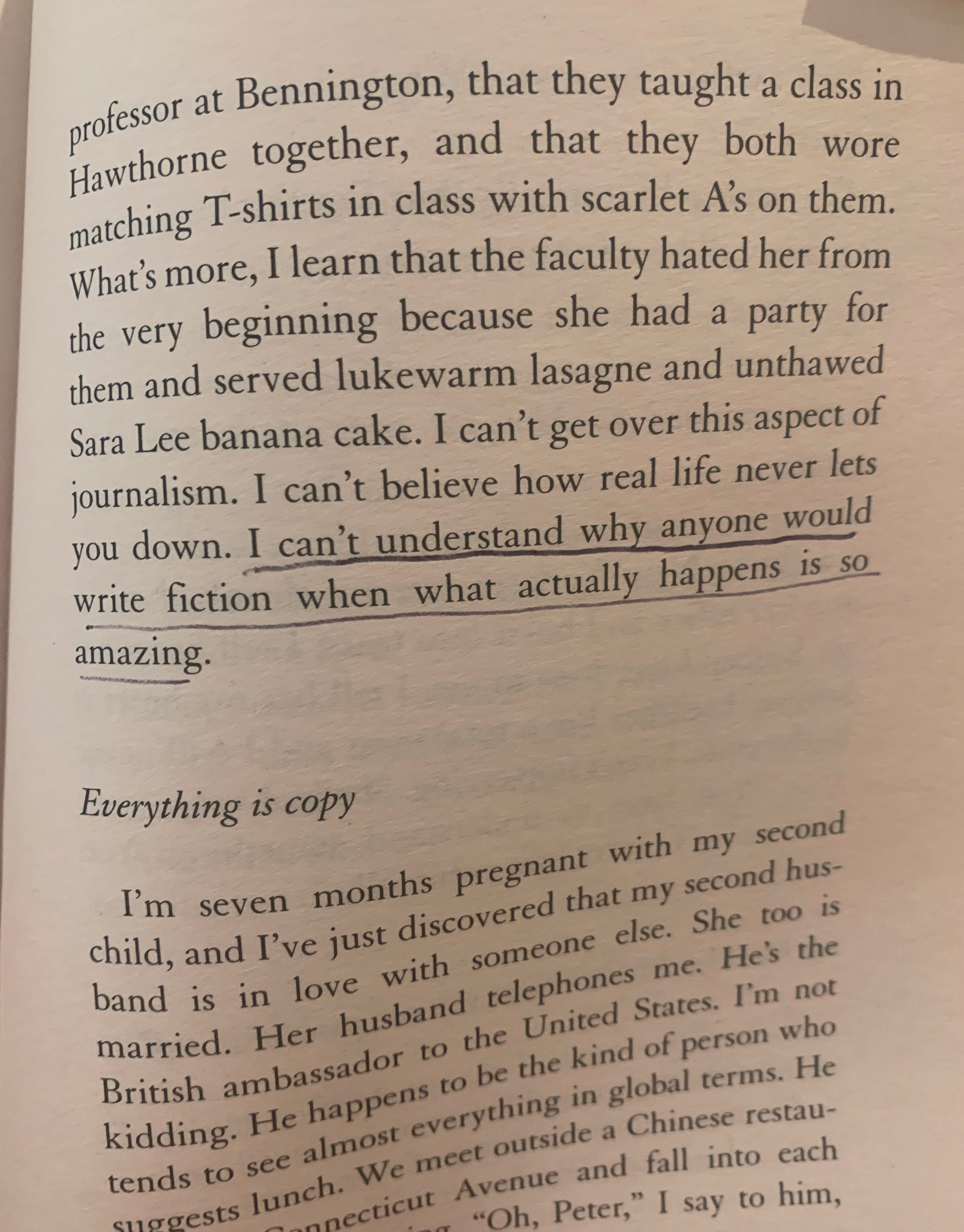
Write what you know, and where to go from there
I’m still trying to find the balance between being honest and sharing too much. I keep reiterating Nora Ephron’s everything is copy in an attempt to remind myself that anything can be good material, I don’t need to pull from my latest sessions in therapy to write something worthwhile. It’s an active exercise, I don’t want to be afraid of living a good life in fear of running out of ideas. I’m still dedicated to doing things for the plot. I’ll try anything once. I’ve gotten to some pretty interesting places by saying yes to [almost] everything. If we are the sum of our experiences, I’m committed to maximising the input, even if everything doesn’t quite make it through the final edits.
Every time I forget how good of a writer you are. CRAZY!!!
This was sooo good and refreshing to read